What a Shared Worktable Makes Possible
A shared worktable changes who can reach materials, see works in progress and join a conversation, while leaving room to keep unfinished work private.

The most common mistake with a shared worktable is treating it as a large desk that happens to have several users. That makes access depend on whoever arrived first, while unfinished work and personal tools drift into view without anyone deciding they should. A shared worktable works better when its surface is understood as a small piece of social infrastructure: what sits within reach invites participation; what is covered or put away stays under its maker’s control.
There are several ways to arrange that balance. An open table keeps materials and activity visible. A zoned table gives shared tools a stable home and reserves separate areas for each person. A cleared, temporary table brings people together for a particular task, then returns to neutral. None is universally best. The right choice depends on whether people need to notice one another’s work, protect long-running projects, or make room for changing groups.
An open shared worktable makes activity visible
On an open table, common materials remain in view and available: a jar of pencils, a tin of clips, scrap paper, masking tape, perhaps a cutting mat. People can see what others are making without asking for a tour. A visitor may notice a colour or tool and ask about it; someone working alone may find that the table makes it easier to join a conversation without arranging a formal introduction. The furniture does not create generosity, but it can reduce the number of small permissions needed to take part.
This approach suits a drop-in studio, community print room, school art space or a group that meets for short sessions. It is especially useful when the activity is exploratory and people benefit from seeing materials used in different ways. A shared supply of offcuts, for instance, can make a resource visible that might otherwise be overlooked in a cupboard.
Visibility also has a cost. A sketch, a lettered draft or an object still being worked out may be treated as an invitation to comment simply because it is exposed. People can move another person’s tools, mistake a work in progress for spare material, or assume that everything on the surface is communal. An open arrangement therefore suits spaces where people already have a workable understanding of consent and where participants can put away or cover what they do not want seen.
It helps to separate visibly shared resources from personal work without turning the distinction into a display. A communal tray can hold pencils and clips; an individual board, envelope or covered box can hold a person’s current work. The useful question is not whether the table looks tidy. It is whether someone new can tell what they may use, what they should leave alone and where to ask.
A zoned table separates common tools from private work
A zoned table assigns different parts of the surface different roles. The middle might hold shared tools, with personal working areas around the edges. Alternatively, each person can have a portable tray, while a marked central area stays open for materials everyone uses. Painter’s tape can indicate boundaries temporarily; a shallow tray or a stack of boards makes a more flexible division when tape would interfere with the work.
This arrangement suits regular groups, especially when participants return to the same project or need to work beside one another without constant exchange. It gives a person somewhere to put a half-finished drawing while leaving the shared scissors accessible. It also makes the social invitation more precise: the common area is available, but proximity does not mean every sheet is up for discussion.
The difficulty is that zones can harden into territory. A boundary intended to protect a sketch may become a claim over the best light or the only clear corner. The person who arrives later may inherit a narrow strip and a view of someone else’s elbow. A layout that appears fair on paper can still favour whoever has the most space, the loudest voice or the longest-standing project.
Keep zones modest and easy to reset. Give shared tools a consistent place, but avoid assigning elaborate permanent territories unless the room and membership genuinely support them. A portable board is useful because it can move with its owner; a fixed line down the table may suggest a precision the group does not have. The aim is a legible boundary, not a miniature border dispute.
A temporary table suits work that changes from session to session
Some groups keep the table mostly clear until a particular activity begins. They bring out only the materials needed for that gathering, work together, then pack everything away. This can mean setting out charcoal and large sheets for a drawing session, or arranging a few reference objects for a shared discussion. The table becomes a meeting point rather than long-term storage.
This approach suits rotating groups, borrowed rooms and spaces used for several purposes. It also works when people want a clear start to a shared activity, rather than the feeling that they are entering someone else’s unfinished project. Clearing the surface makes it easier to decide what the group is doing now, and it limits the chance that old materials will be mistaken for current instructions.
The trade-off is that unpacking and packing away take attention. If the session is short, arranging supplies can consume the time people hoped to spend making. Some work also needs to remain visible between meetings: a collaborative paper layout, a set of test pieces or a composition whose parts make sense only together. A temporary arrangement is a poor fit when continuity depends on leaving the work in place.
Where continuity matters but the room must be cleared, a portable board or shallow project box can preserve the arrangement. It keeps pieces together without claiming the whole table between sessions. This is a practical compromise, not a reason to save every scrap. If an item has no clear role in the ongoing work, it need not acquire tenure merely because it has been on the table for a while.
Choose the arrangement by deciding what should stay within reach
Start with access, not furniture. Which tools do people need to share? Which materials can be replenished easily? Which works need to remain visible for discussion, and which should be private unless their makers choose otherwise? Those answers point towards an open, zoned or temporary arrangement. A room can also combine them: an open communal tray, separate personal boards and a cleared centre for group work.
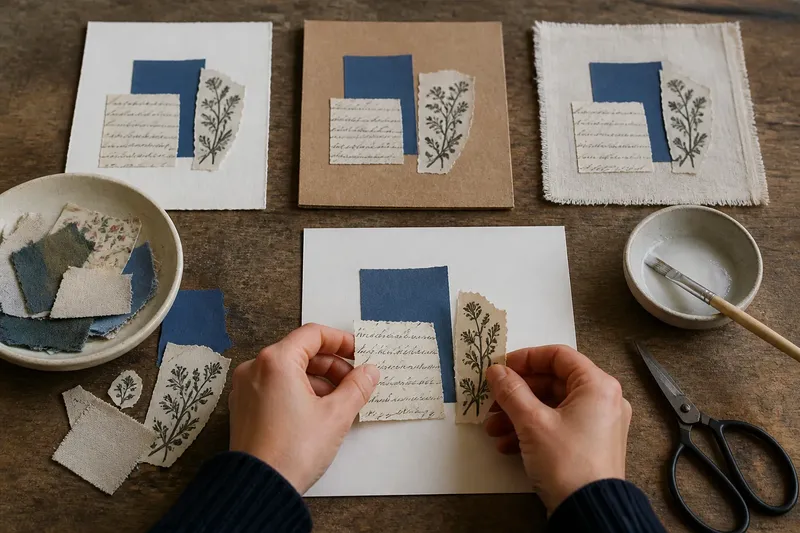
Say a small group meets in a borrowed room to make collages, and one participant wants to keep a developing composition intact between sessions. They could use an open tray for shared scissors and glue sticks, keep the composition on a personal board, and clear the middle for the current session’s scraps. The expected observable result is straightforward: newcomers can identify supplies they may use, the unfinished arrangement remains together, and the table can still support work shared by the group. If the board starts crowding out others, the group has a visible reason to revisit the arrangement rather than leaving the problem to guesswork.
As a simple decision guide:
- Choose an open table when spontaneous exchange and visible materials matter more than keeping works in progress on the surface.
- Choose zones when people need both a shared supply point and a protected area for individual work.
- Choose a temporary setup when the room or group changes often and each session needs a fresh beginning.
- Combine approaches when the group has distinct needs, but keep the boundary between communal and personal materials obvious.
Not worth the effort: labelling every pencil, sorting scraps into tiny categories or designing a complicated colour code for a table used by a small group. A few clear containers and a shared understanding of what belongs where usually do more. Add a label only when people repeatedly make the same wrong assumption; decoration is not a substitute for a usable arrangement.
How does a shared worktable handle unfinished work?
Should unfinished work stay on the table?
Leave it there only if the group has agreed that the surface is available between sessions and the maker is comfortable with others seeing it. Otherwise, use a board, folder or box that can be moved without rearranging the work.
How can a new participant tell what is communal?
Keep shared tools together in a consistent, visible container and separate them from personal supplies. A brief welcome can explain the arrangement, but the table should make the distinction understandable without requiring a private introduction.
What helps people exchange ideas without unwanted critique?
Make conversation available rather than compulsory. People can invite comments by placing work in a shared discussion area, while boards or covered folders signal that a piece is not currently being offered for review.
Can one table serve a changing group?
Yes, if the arrangement can be reset without a long negotiation. Keep shared materials portable, leave personal work easy to remove, and make any session-specific area temporary rather than treating it as a permanent claim.
Small table habits shape who feels able to join
A shared surface is not neutral simply because everyone can approach it. Its arrangement tells people whether they may reach for the tape, whether a page is available to look at and whether there is room for a newcomer to begin. Those messages can be quiet, but they still affect who joins in and how much they have to ask before doing so.
For a shared worktable, the most useful design decision is often modest: put common materials where they can be reached, give private work a clear place to go, and leave enough open surface for the next person. That balance can be adjusted as the group changes. The table need not settle every question about collaboration; it should make the immediate ones easier to see.