Loose Sheets or a Sketchbook: How to Keep Visual Ideas Findable
Loose sheets or a sketchbook can each help you revisit visual ideas. Choose a format that suits comparison, sequence and the way you search.
The common mistake with collecting visual ideas is binding every mark into a sketchbook before deciding how you will revisit it. A page may be easy to fill but awkward to compare; a loose sheet may be easy to compare but easy to misplace. Loose sheets or a sketchbook is a practical choice about what you want to find later, not a contest between formats.
Neither format has to do everything. Loose sheets can be rearranged, while a bound book keeps pages in sequence. Choose according to the kind of return you expect to make.
Choose the question your collection should answer
Name why you are keeping the images. You might want to compare how a shape changes, collect observations of a place, or preserve passing marks without deciding what they mean. Each purpose asks for a different kind of order.
If comparison matters, loose sheets let you place related drawings beside one another. If development over time matters, a bound book keeps the order in which marks were made. A collection can hold both, but decide which kind of material needs to be easiest to retrieve.
Write a short description on a spare card or inside the cover. “Street corners to redraw” or “variations on a folding chair” is enough. This is a reminder, not a filing system in search of a filing system.
Set up loose sheets for easy comparison
Choose paper that can be handled comfortably. Drawing paper kept in a labelled envelope or shallow document box works well for many informal collections. Keep a pencil nearby for a date, place or brief note; without context, a drawing can become an elegant puzzle.
Use the same orientation for each sheet and put notes in the same corner. Group pages by one visible cue, such as subject, location, material or a question. A paper divider or labelled envelope is usually enough. Avoid sorting by every possible quality at once. A small collection need not acquire the administrative habits of a council office.
When you return to the work, lay out a few sheets together. Compare recurring lines, changes in proportion or details you had overlooked. Then return them to the same group, or move a sheet if its relationship has changed. The advantage of loose paper is not the absence of order; it is the ability to revise it.
Use a bound book when sequence matters
A sketchbook makes the order of ideas part of the record. Each page follows another, so you can read a later drawing against what came before. This helps when you want to follow a visual question as it develops, including the attempts that a tidier collection might omit.
Choose a binding that opens comfortably for the way you draw. A book that resists lying flat can make a large image awkward; a small format may encourage quick observations but constrain a sprawling composition. Leave a margin for notes or later connections, and use the first page to identify the subject if the book has one.
Keep unrelated observations together if their sequence is useful. If you need to locate a recurring subject, add a simple index at the back: page number and a few words. Do not rewrite the whole book as a catalogue. An index should help you find a page, not turn drawing into administration.
Combine formats without losing the trail
Sometimes an idea begins in a book and later needs to be compared outside it. Keep the original page in sequence, then make a separate copy or note its page reference on a loose sheet. Before detaching a page, record where it came from. Otherwise, the drawing may survive while its place in the thinking disappears.
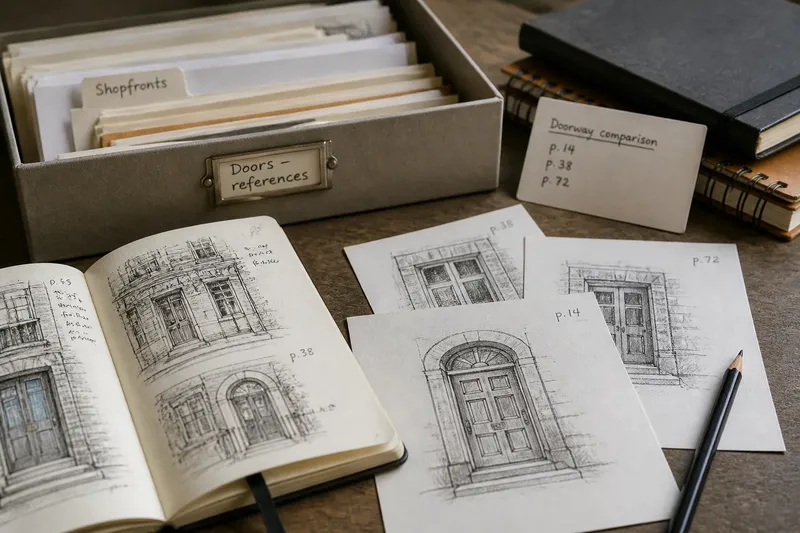
Say you have a sketchbook with unrelated drawings and want to compare its shopfront doorways. In this invented situation, the starting material is a book with three doorway sketches on different pages. First, write those page references on a small index card. Next, draw each doorway on a separate sheet and note the matching page number. Finally, lay the sheets side by side. The observable result is a direct comparison of the shapes, while the page references preserve their original sequence. The trade-off is a little extra copying and indexing.
Use a folder for sheets that need to travel together. For fragile or valuable work, follow suitable handling and storage advice for the paper and materials involved rather than forcing it into a format that does not fit.
Which format suits the way you revisit ideas?
Are loose sheets better for visual comparison?
They help when you want to arrange, separate and compare images side by side. Keep them in a labelled folder or box so the comparison does not depend on remembering where each sheet went.
Does a sketchbook need to follow one subject?
No. One subject can make later searching simpler, while mixed subjects preserve the order in which observations arrived. Choose according to whether easy searching or continuity matters more.
How can I keep loose drawings in sequence?
Number the sheets lightly in a consistent corner and store them in order. If you later regroup them, note the original sequence on a cover card or in a separate index.
What should I do with pages I may want to remove?
Record the page reference before removing it, then keep the sheet with a note linking it to the book. If the paper is delicate or the work matters to you, leave the page in place and make a copy instead.
Use a small retrieval system you will maintain
Before settling on a format, check what you have and decide what each observation means; if a page needs comparison, use loose sheets, but if its order matters, keep it in a book. Check whether loose sheets have a clear home; if they do, use that folder or box, but if they do not, label one before adding more. Check whether you will search by subject; if so, add a brief index, but if not, leave the book unindexed. Check whether a sheet needs a link to its source; if it does, write the page reference on it, but if it does not, avoid adding a redundant note. Check whether the material is fragile; if it is, follow suitable storage advice, but if it is not, use ordinary careful handling. Check whether the arrangement still makes sense when you return; if it does, keep it, but if it does not, change the grouping and record any sequence you need to retain.
It is not worth building a detailed code for every medium, subject and mood unless you genuinely use those distinctions. For a practical start, choose one bound book for work whose order matters and one folder for images you want to compare. Loose sheets or a sketchbook is ultimately a choice about revisiting: one lets you change the arrangement, the other preserves the path through it. Aim to find the thought again, not to make it look as if it arrived fully formed.