A First Visit to a Small Exhibition
A first visit to a small exhibition feels less hurried when you choose one work, follow a simple looking routine and leave with a useful question.
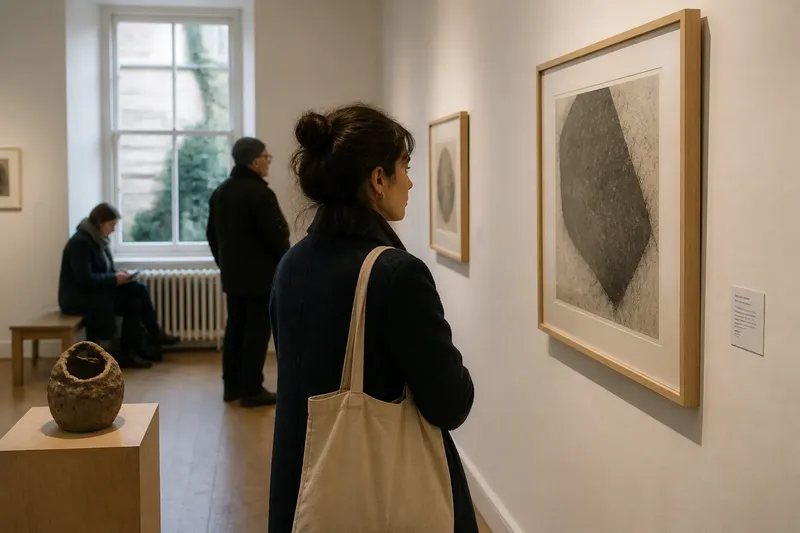
The most common mistake on a first visit to a small exhibition is treating every work as a stop on a route you must complete. The cost is attention: you leave with a blur of objects instead of a detail you can recall. A first visit to a small exhibition works better when you choose one piece, look closely, and let the room help set the pace.
Arrive by noticing how the room works
Pause near the entrance before reading every label or heading straight for the nearest work. Notice the entrance, the likely direction of movement, and whether there is a bench or a clear place to stand aside. This gives you a practical starting point, not a test in gallery etiquette.
In a compact room, visitors often share a close view. If someone is reading a label, wait or look elsewhere rather than forming a queue behind them. Follow a suggested route if the exhibition marks one; otherwise, you can begin wherever your attention lands.
You need no specialist vocabulary or notebook. Quiet looking is a complete way to take part. If you are carrying a coat or bag, keep it close enough not to obstruct other visitors or the work.
Choose one work and look before interpreting
Walk through at an easy pace and choose a work that holds your attention. It might be a piece you find puzzling, one you nearly passed, or one made from a familiar material. Do not worry about selecting the most important work. An exhibition need not have a single centrepiece.
Stand far enough away to see the whole piece, then move closer only if the space allows and the display invites it. Look for a repeated mark, a rough edge, a change in texture or a detail that was hard to see from the doorway. Respect barriers and other instructions rather than leaning in for a better view.
Say you enter a room with framed prints and a small clay object by a window. You choose a print whose dark shape looked plain from the entrance. From closer up, faint lines cross the shape; you wonder whether they belong to the image or the paper. The result is a precise question, not a demand for the right interpretation.
Use a small looking routine you can carry through the visit
A short checklist can keep attention on the work without turning the visit into an assignment. Use each observation to decide what to do next:
- Check the whole view: Can you see the work without blocking anyone? If yes, pause where you are; if not, move to a clear spot or wait for the view to open.
- Check the first detail that caught your eye: Is it still holding your attention? If yes, follow it across the work; if not, shift to a different feature, such as an edge or empty area.
- Check the surface and material: Can you distinguish a texture, mark or material from where you stand? If yes, note what is visible; if not, move closer only where permitted, or accept that the detail is out of view.
- Check the label: Does it identify a medium or give context that changes what you notice? If yes, read that information and look again; if not, leave the label and continue looking.
- Check the room around the work: Is glare, traffic or a doorway pulling your attention away? If yes, try another permitted position; if not, stay with the view you have.
- Check your attention: Do you want to return to the work after looking elsewhere? If yes, go back for another look; if not, move on without adding time for its own sake.
- Check what you can carry away: Can you name one detail or question? If yes, keep it in mind or write it down; if not, choose one visible feature before leaving the room.
These are prompts, not obligations. Skip any item that does not fit the space or your attention. Not worth the effort: photographing every label or trying to memorise every title. Read a label when it helps, and take a photograph only if the venue permits it and you have a reason.
Notice what the room changes
Widen your view while keeping the chosen work in sight. Notice the light, wall colour, distance between pieces and sounds such as footsteps or conversation. These surroundings can affect how easily you look, even when they are not part of the work.
Placement has an effect too. A piece beside a doorway may be interrupted by passing visitors; one in a corner may invite a quieter look. You do not need to decide whether the arrangement succeeds. Notice what it makes easy or difficult to see.
If the room allows it, shift your position slightly. A reflection might obscure a surface from one angle and reveal it from another. Do not turn every change into a theory. Sometimes the useful observation is simply that the window is in the way.
Let other works make connections without forcing a story
After looking at one work, glance around for a possible connection: a repeated colour, material, shape or subject. The link might be clear, tentative or absent. Works can share a room without forming a tidy story.
If a label points to a relationship, see whether you can spot it. You may find a repeated line or a shared subject; you may find no visible link at all. Leave the question open rather than making every object support one theme.
You need not compare your response with what you imagine an experienced visitor would say. “I keep looking at the lower edge” is already a specific observation. Liking the work or understanding it immediately is not a condition of looking carefully.
Decide when to pause and when to leave
Step back or use a seat if one is available. A pause can tell you whether you want to return to the work or whether your attention has moved on. There is no need to stay longer just to demonstrate seriousness.
If you return, look again at the detail that first caught your eye. It may now seem less important, or it may hold your attention for a different reason. Either way, you have noticed a change in your response.
Before leaving, choose one question tied to something you actually saw. “Why does this edge feel unfinished?” is more specific than “What does it mean?” You can write the question down, share it with a companion or simply carry it with you. A visitors’ book is optional; the room does not need a public verdict from every person who enters.
What should you do when a visit feels difficult?
Can I skip works and return later?
Yes. Move aside when someone needs the same view, then return if the space opens up. A small exhibition does not require one uninterrupted circuit.
Should I read the labels before looking?
Choose the order that suits your attention. Looking first lets you form an initial impression; reading first can provide useful context about materials or presentation.
What if I do not understand the work?
Start with something visible: a colour, mark, material or the way the work occupies space. You can have a worthwhile encounter without arriving at a complete explanation.
How long should a first visit take?
Stay while your attention remains available, then leave when it does not. The size of the room does not set a timer, and careful looking can happen during a short visit.
A first visit to a small exhibition need not produce a polished response. Choose one work, notice one thing the room makes easier or harder to see, and leave with a question attached to a detail. That gives your next encounter somewhere specific to begin.